← Home · Ground improvement

Vibrocompaction Design in Manchester, NH – Granular Soil Densification

Together, we solve the challenges of tomorrow.

LEARN MORE →

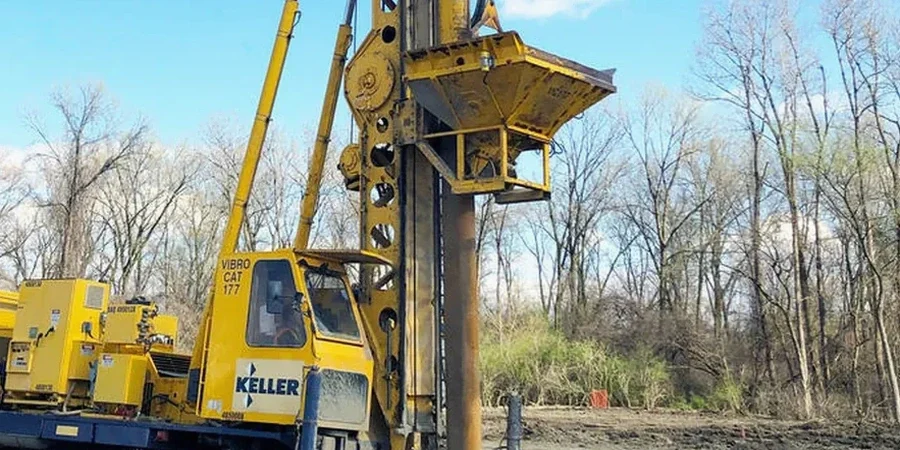
In Manchester, many job sites east of the Merrimack River hit loose glacial outwash within the first 15 feet. That material looks dense on a boring log until you run a standard penetration test and get N-values below 10. We design vibrocompaction programs that target those weak zones directly, raising relative density past 70 percent before footings or slabs go in. The process uses depth-controlled vibratory probes to rearrange sand and gravel particles into a tighter packing arrangement. No imported fill, no cement, no water — just mechanical energy applied at the right grid spacing. Our approach leans on decades of local cone data and the USCS classification system to predict how the deposit will respond before mobilization. For deeper verification we often pair the design with a CPT campaign that captures sleeve friction and pore pressure in real time, confirming that target density is reached across every probe location.

A well-designed vibrocompaction grid turns N-values of 8 into N-values of 25+ without a single truckload of imported stone.

Methodology and scope

Manchester sits at roughly 210 feet elevation on a river terrace system where the subsurface flips from dense glacial till to loose alluvium over short distances. That variability demands a design grid tighter than what generic charts suggest. We size probe spacing — typically 5 to 8 feet triangular — using seed gradations from laboratory grain-size analysis of material pulled from the target stratum. The analysis confirms whether the soil falls in the vibro-compactable range: less than 15 percent fines, D10 above 0.05 mm, and a uniformity coefficient that supports particle rearrangement. Our lab runs ASTM D2487 classification on every sample so the design isn't built on assumptions. Power draw, amperage peaks, and probe penetration rate during the trial phase feed back into the grid adjustment, and we document the correlation between blow counts before and after treatment. The result is a verifiable density improvement without over-compacting zones that already meet structural requirements.
Vibrocompaction Design in Manchester, NH – Granular Soil Densification
Technical reference image — Manchester New Hampshire

Local geotechnical context

The risk profile between the sandy deposits near the airport and the silty terraces west of Elm Street is fundamentally different. On the west side, glacial lake sediments carry enough silt to push the fines content past 18 percent, and that kills vibrocompaction efficiency almost immediately. In those areas, forcing a vibratory probe just densifies a small annulus around the tip while the bulk mass stays loose — a waste of rig time. We flag those zones early with a particle-size check and shift the ground improvement strategy toward stone columns when the silt fraction exceeds the threshold. The other common failure mode in Manchester is underestimating groundwater elevation, which sits within 8 feet of grade across much of the valley floor. A high water table reduces effective stress and can mask poor compaction if verification testing isn't run with pore pressure dissipation factored into the cone resistance interpretation.

Need a geotechnical assessment?

Reply within 24h.

Email: contact@geotechnical-engineering.vip

Reference parameters

ParameterTypical value
Target relative density (Dr)≥ 70% (typical for shallow footings)
Max fines content for effective densification< 15% passing #200 sieve
Typical grid spacing (triangular)5–8 ft center-to-center
Depth capability (standard electric vibroflot)Up to 100 ft below grade
Post-treatment verification methodCPT tip resistance + SPT correlation
Applicable standard for soil classificationASTM D2487 (USCS)
Seismic design referenceASCE 7 Chapter 20 + site class improvement

Complementary services

01

Granular soil suitability screening

We run ASTM D2487 classification and grain-size curves on samples from each target layer to confirm the deposit falls within compactable gradation bands before any rig is mobilized.

02

Trial grid design and field calibration

Spacing, probe energy, and penetration sequence are set during a trial phase. We track amperage logs and CPT tip resistance to lock the production grid parameters.

03

Post-densification verification

CPT soundings at grid centerpoints and midpoints quantify the density increase. We correlate cone resistance to SPT N60 values and issue a stamped report referencing IBC acceptance criteria.

Reference standards

ASTM D1586 – Standard Penetration Test, ASTM D2487 – USCS Soil Classification, ASCE 7-22 Chapter 20 – Site Classification for Seismic Design, IBC 2021 Section 1803 – Geotechnical Investigations

Frequently asked questions

What soil types in Manchester respond best to vibrocompaction?

Clean sands and gravels with less than 15 percent passing the #200 sieve. Glacial outwash deposits found along the Merrimack River corridor and near the airport fit this profile well. Silty glacial lake sediments, more common west of downtown, usually need an alternative approach because the fines dampen vibration transmission.

How much does vibrocompaction design cost for a typical Manchester project?

Design fees generally range from US$1,300 to US$5,170 depending on the treated area, number of probe locations, and depth of the target stratum. A small commercial lot under 10,000 square feet sits at the lower end, while a multi-acre industrial site with deep loose sand and full CPT verification runs toward the upper bound.

How do you verify the ground actually improved after treatment?

We run CPT soundings at the center of each probe grid cell and compare tip resistance and friction ratio against pre-treatment baselines. When the data show a consistent increase in cone resistance that correlates to a relative density above 70 percent, the treatment is accepted. SPT checks are added where project specifications require blow count documentation.

Does a high water table affect vibrocompaction results?

A shallow water table, common across the Manchester valley floor, reduces effective stress and can produce misleadingly low cone resistance readings right after treatment. We account for this by allowing a short dissipation period before verification testing and by interpreting CPT data with pore pressure correction, so the density assessment reflects actual improvement rather than temporary excess pore pressure.
Location and service area

We serve projects in Manchester New Hampshire and surrounding areas.

View larger map