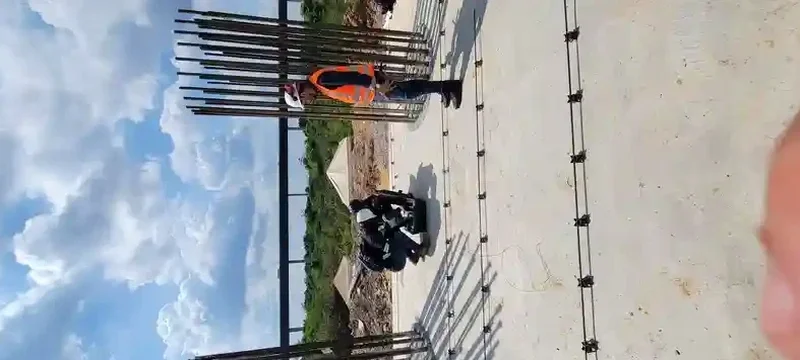
Calling it "bedrock" before you have the shear wave numbers is a gamble that costs Manchester projects real money. Some of the older mill-era fill near the Merrimack River looks competent in a test pit but can clock VS30 values under 600 ft/s. That pushes you into Site Class D or E under ASCE 7-16 Chapter 20, and suddenly your seismic base shear jumps. The MASW survey cuts through the guesswork. We run a 24-channel array with 4.5 Hz geophones, shoot a sledgehammer source, and invert the dispersion curve to get a one-dimensional VS profile down to 30 meters. The profile feeds directly into the liquefaction screening logic for the saturated silty sands common across the Manchester quadrangle. If the client needs deeper bedrock confirmation on a riverfront parcel, we pair the MASW line with a seismic refraction spread to cross-check the velocity model against a P-wave tomogram.
A VS30 under 600 ft/s is the line between Site Class C and D in the IBC — and that single jump can double the design seismic load for a Manchester structure.
Local geotechnical context
One thing we keep seeing in Manchester: a boring log that hits refusal at 15 feet gets classified as Site Class B by default, but the MASW profile tells a different story. A fractured schist or a weathered granite layer can show refusal on the split-spoon yet still transmit shear waves at 1,800 ft/s, not the 2,500+ you need for Class B. Misclassifying by one letter changes the seismic coefficient Cs in the ELF analysis, and the structural design becomes unconservative. The other quiet risk is working too close to the railroad corridor along the river. Ground-borne vibration from freight trains saturates the low-frequency geophones if you don't time the acquisition between runs. We check the Pan Am Railways schedule for the Hillsborough Branch before setting the spread. Skipping that step produces a noisy dispersion image that no amount of post-processing can clean up.
Top questions
How much does a MASW survey cost for a typical Manchester commercial lot?
For a standard active-source MASW survey on a Manchester commercial lot under one acre, the fieldwork, processing, and site class report typically run between US$1,750 and US$3,280. The range depends on access conditions, number of shot locations required, and whether the city requests additional documentation beyond the standard ASCE 7 site class letter.
What's the difference between MASW and a downhole seismic test for VS30?
MASW is a non-invasive surface method that uses an array of geophones and a sledgehammer source to measure surface-wave dispersion. A downhole test requires a drilled borehole and measures body-wave travel times directly. MASW typically gives better lateral averaging and costs less, but a downhole test can resolve thin velocity inversions that MASW's fundamental-mode inversion might miss. For most Manchester site classifications, MASW is the more practical first option.
Does the City of Manchester accept MASW data for the IBC site classification?
Yes, the Manchester building department accepts MASW-derived VS30 values for IBC site classification, provided the survey is performed and stamped by a licensed geotechnical engineer. The report must include the dispersion curve, the inversion model, and the VS30 calculation in the format prescribed by ASCE 7 Chapter 20.
How long does the fieldwork take on site?
A standard MASW line with three shot points on a cleared Manchester lot takes about 90 minutes of acquisition time. The crew needs roughly an hour before that to lay out the cable, level the geophones, and run a noise check. If the site is in a high-traffic area near Elm Street, we schedule the survey for early morning to keep ambient vibration low.