← Home · In-Situ Testing

Field Density Testing in Manchester, NH – Sand Cone Method (ASTM D1556)

Together, we solve the challenges of tomorrow.

LEARN MORE →

Manchester sits on a glacial outwash plain where sands and gravels dominate, but pockets of fine-grained lake sediments from Glacial Lake Merrimack create uneven compaction potential across the city. The Merrimack River terraces add another layer of variability—clean granular fills can look solid on the surface yet mask voids a foot down. When the New Hampshire Department of Transportation specs call for 95% standard Proctor on a trench backfill, the only way to confirm that number is a direct in-place measurement. We run the sand cone density test across Hillsborough County, from Elm Street commercial pads to residential subdivisions off South Willow, and the data consistently shows that even well-graded bank-run gravel needs verification lift by lift. For projects where deeper investigation is warranted, we often pair the density readings with test pits to visually inspect layer boundaries before compaction begins.

A Proctor number without a field density verification is just a lab promise—the sand cone test delivers the field proof Manchester inspectors require.

Methodology and scope

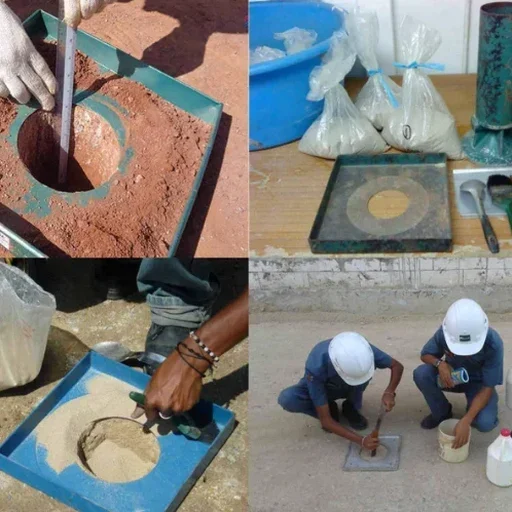
In Manchester, many foundation crews encounter what we call the 'spring-thaw false set'—ground that feels firm in March but settled unevenly over winter. The sand cone method cuts through that guesswork. We excavate a precise hole at the compacted surface, measure every gram of removed soil, and backfill with calibrated Ottawa sand to determine the in-place dry density. The math is straightforward, but execution requires strict adherence to ASTM D1556, especially on silty sands near the airport where moisture content swings by 8% between morning and afternoon. Our team runs rapid moisture correction using a Speedy meter on site, so the compaction ratio gets calculated before the next truck arrives. When the subgrade proves marginal, we recommend supplementing with a plate load test to evaluate bearing capacity and elastic modulus under simulated service loads.
Field Density Testing in Manchester, NH – Sand Cone Method (ASTM D1556)
Technical reference image — Manchester New Hampshire

Local geotechnical context

Under the IBC 2021 Chapter 18 and ASCE 7-22 Section 12.13, Manchester lies in a Seismic Design Category B zone, but the real risk here is not shaking—it is differential settlement from poorly compacted structural fill. A single lift compacted at 88% instead of 95% can induce post-construction settlement exceeding 1 inch, cracking slabs and shifting utility connections. Frost penetration in Hillsborough County reaches 48 inches per NHDOT Standard Specifications Section 203, meaning any density test taken above that depth without accounting for frozen soil moisture gives falsely high dry density readings. We have seen compacted gravel pads that passed field density in October fail by March because ice lenses formed in the underlying silt. The sand cone test executed per ASTM D1556 with proper moisture correction eliminates that seasonal blind spot and provides defensible documentation for the Manchester Building Safety Division.

Need a geotechnical assessment?

Reply within 24h.

Email: contact@geotechnical-engineering.vip

Reference parameters

ParameterTypical value
Applicable standardASTM D1556 / AASHTO T 191
Test depth range0–12 in (305 mm) per lift
Calibrated sandASTM C778 20–30 Ottawa sand
Minimum test hole volume3x max particle size per ASTM D4718
Typical reporting metric% Standard Proctor (ASTM D698)
Moisture determinationSpeedy moisture tester or oven-dry per ASTM D2216
Applicable soil typesGranular soils up to 1.5 in max particle size, fine-grained soils

Complementary services

01

Structural Fill and Backfill Verification

Density testing per ASTM D1556 on building pad fills, retaining wall backfill, and basement excavations. We test each 8-inch lift before the next placement and document results on the NHDOT Form 205A when required.

02

Utility Trench Compaction

Manchester Water Works and Eversource both require density records in the public right-of-way. We test pipe zone backfill and trench plugs, with special attention to the haunch area under rigid pavements along Candia Road and Mammoth Road.

03

Subgrade Proof Rolling Support

Before proof rolling a parking lot subgrade, we run a grid of sand cone tests at 50-foot centers to establish the pre-rolling density baseline. This identifies soft pockets in glacial lake deposits that proof rolling alone can mask.

Reference standards

ASTM D1556 – Standard Test Method for Density and Unit Weight of Soil in Place by Sand-Cone Method, ASTM D698 – Standard Test Methods for Laboratory Compaction Characteristics of Soil Using Standard Effort (12,400 ft-lbf/ft³), ASTM D2216 – Standard Test Methods for Laboratory Determination of Water (Moisture) Content of Soil and Rock by Mass, AASHTO T 191 – Density of Soil In-Place by the Sand-Cone Method, IBC 2021 Chapter 18 – Soils and Foundations, NHDOT Standard Specifications for Road and Bridge Construction, Section 203

Frequently asked questions

How much does a field density test cost in Manchester?

A single sand cone density test in the Manchester area typically runs between US$90 and US$130 per point, depending on site access, number of tests per mobilization, and whether companion Proctor curves already exist. Sites requiring more than 10 tests per day usually qualify for reduced per-point pricing.

How many density tests does the Manchester building inspector require for a residential foundation?

The Manchester Building Safety Division generally follows IBC Table 1705.6, requiring one field density test per lift per 2,500 square feet of building pad, with a minimum of one test per lift regardless of area. For a typical 2,000 sq ft single-family home with three lifts, expect at least three sand cone tests.

Can you run a sand cone test on crushed stone base course?

ASTM D1556 works on granular soils with maximum particle sizes up to 1.5 inches. For crushed stone with larger aggregate or significant void space, the sand cone method can overestimate density. On those materials we often recommend a nuclear gauge comparison or a plate load test for modulus-based acceptance.

How long after compaction should the sand cone test be performed?

The test should be performed on the same day the lift is compacted, ideally within two hours of final roller pass. In Manchester's humid summers, moisture content in exposed silty sand can shift measurably within a single afternoon, so we schedule testing to follow immediately behind the compaction crew.

What documentation do I receive after a density test?

You receive a signed field report showing test location on a site plan, lift number, measured wet density, moisture content, dry density, maximum dry density from the lab Proctor, and the calculated compaction percentage. We archive all reports for the NHDOT seven-year retention period and can provide PDFs within two hours of testing.
Location and service area

We serve projects in Manchester New Hampshire and surrounding areas.

View larger map