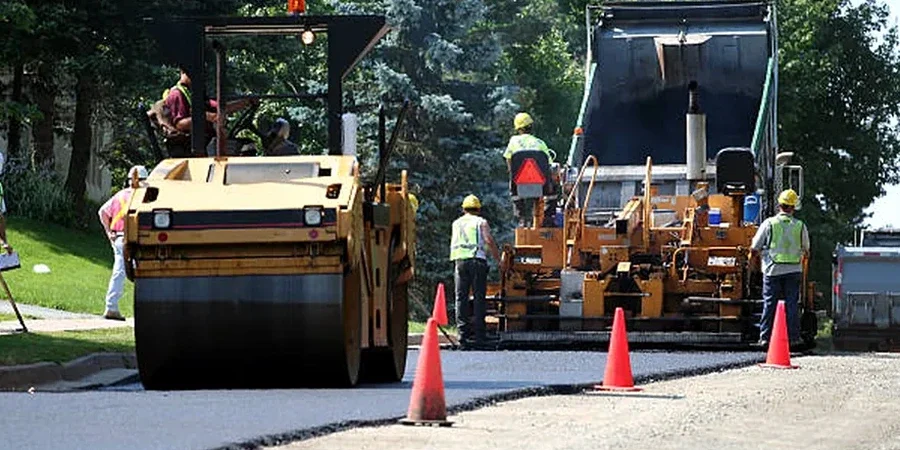
The soil composition beneath a commercial lot on Elm Street is rarely the same as what you encounter near the Merrimack River or in the Goffstown Road area. Manchester's glacial history left behind a patchwork of dense till, sandy outwash, and pockets of marine clay — and each one responds differently under repeated traffic loads. A pavement section that performs well in the North End may rut prematurely near the airport if the subgrade wasn't characterized properly. That's why flexible pavement design in Manchester has to start with a clear picture of what lies below the surface. We combine site-specific geotechnical investigation with the AASHTO 1993 design method, adjusting structural numbers based on real CBR values, frost penetration depth, and the drainage characteristics of the native soil. When the subgrade shows marginal strength, a CBR road assessment quantifies exactly how much improvement is needed before the first lift of asphalt goes down.
A flexible pavement is only as durable as the subgrade it rests on — and in Manchester, that subgrade can change completely within a single city block.
Local geotechnical context
We reviewed a parking facility off South Willow Street where the owner had repaved twice in six years, and the problem was never the asphalt mix — it was the saturated silt layer sitting four feet below the subbase, trapped by an impermeable clay lens that nobody had identified. The original design assumed free-draining conditions, but the reality was a perched water table that kept the subgrade at near-saturation for months. Flexible pavement design without a site-specific geotechnical investigation is just guesswork dressed up in layer coefficients. In Manchester's variable terrain, skipping the subsurface exploration means accepting the risk of alligator cracking, differential rutting, and base erosion that shows up two winters later. The cost of a proper investigation and a pavement design that accounts for frost action and drainage is a fraction of a full-depth reconstruction after premature failure.
Reference standards
AASHTO Guide for Design of Pavement Structures (1993), ASTM D1883 (CBR of laboratory-compacted soils), ASTM D1557 (Modified Proctor compaction), NHDOT Standard Specifications Section 304 (Aggregate Base), ASTM D422 / D6913 (Particle-size analysis), ASTM D2487 (USCS soil classification), IBC Chapter 18 (Soils and foundations, for pavement-related earthwork)
Top questions
How much does a flexible pavement design cost for a project in Manchester?
For most commercial and municipal projects in the Manchester area, the fee for a full flexible pavement design — including subgrade investigation, laboratory CBR testing, traffic analysis, and the structural design report — typically falls between US$1,910 and US$5,470. The final number depends on the project size, the number of borings or test pits required, and the complexity of the drainage analysis. We provide a fixed-price proposal after reviewing the site location and the planned loading conditions.
What is the difference between flexible and rigid pavement for Manchester's climate?
Flexible pavement — the layered asphalt-on-aggregate system — distributes load through the base and subbase to the subgrade, and it tolerates the seasonal ground movement caused by Manchester's freeze-thaw cycles better than rigid concrete slabs, which are more prone to joint faulting when the subgrade heaves. Flexible pavements also allow for staged construction and simpler rehabilitation; you can mill and overlay without replacing the entire section. The trade-off is that they require more frequent surface maintenance, but in a climate with 60-plus inches of annual snowfall and aggressive plowing, that maintainability is often an advantage.
Do you need to do soil borings before designing a flexible pavement in Manchester?
Yes — and skipping this step is the single most common cause of premature pavement failure we see in the Manchester area. The borings provide the subgrade soil classification, the in-situ moisture content, and the CBR or resilient modulus value that feeds directly into the AASHTO structural number equation. Without that data, you are designing to an assumed subgrade strength, and given how rapidly the soil types change across the city — from granular outwash near the river to fine-grained lacustrine deposits farther east — the assumption is rarely correct. We typically recommend one boring per 5,000 square feet of pavement area, with depths extending at least four feet below the proposed subgrade elevation.