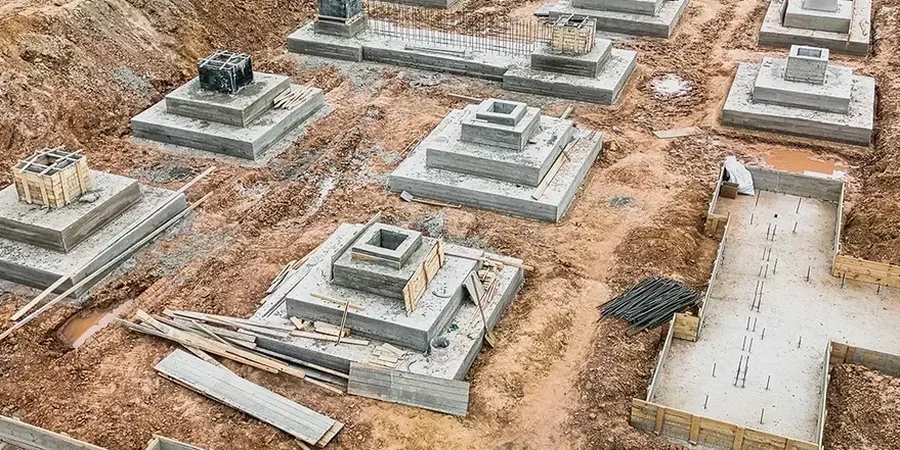
IBC Section 1810 is non-negotiable when you build on the Merrimack River's glacial deposits. Manchester's subsurface is a mixed bag of dense till, varved silts, and organics. We see it daily. Standard shallow footings can fail here, which is why pile foundation design drives most mid-rise and industrial projects in the city. This isn't guesswork. We correlate CPT test data from the river terraces with laboratory index properties, then run static capacity methods (alpha, beta, Lambda) to size driven H-piles or drilled shafts. For lighter structures near Amoskeag, we sometimes pair deep foundations with footings on engineered fill, but only after settlement analysis confirms compatibility. The city's 115,000 residents live atop a complex glacial stratigraphy—our designs account for that reality from day one.
A pile driven to refusal in Manchester till can still fail a week later if the silt layer below it squeezes.
Local geotechnical context
Manchester sits at 210 feet elevation, but the real story is the 50 to 150 feet of glacial lake sediments under downtown. Varved clays from Lake Hitchcock create a preconsolidated crust that fools the unwary. You excavate 20 feet, everything looks solid, then you load a pile group and differential settlement tears the structure apart. We've investigated three building distress cases in the Millyard district, all tied to pile foundation design that ignored the softening effect of excavation rebound. Another risk: the city's dense glacial till contains erratic boulders the size of cars. An unbraced pile can walk off a boulder and lose end bearing instantly. Our designs always include minimum penetration requirements into competent till and lateral stability checks for the soft upper layers. With a population density of 3,400 per square mile, a pile failure here doesn't just damage one building—it threatens adjacent properties.
Top questions
How much does pile foundation design cost for a project in Manchester?
Design fees typically range from US$1,450 for a straightforward single-pile analysis to US$6,720 for a full foundation package with lateral analysis, group effects, and load test supervision. The spread depends on the number of borings, complexity of the soil profile, and whether we're designing driven piles, drilled shafts, or micropiles.
What soil conditions in Manchester require piles instead of shallow footings?
The glacial Lake Hitchcock varved clays and loose alluvial sands along the Merrimack River are the main culprits. If SPT blow counts are below 8 in the upper 30 feet, or if we encounter organics and peat, shallow footings won't work. We also recommend piles when building on the dense till directly if the overlying soils are compressible and settlement would exceed one inch.
Do you handle the pile load testing or just the design?
We handle both. Our engineers write the load test specification, mobilize the reaction frame and instrumentation, run the test per ASTM D1143, interpret the results, and recalibrate the pile foundation design if needed. Having the designer on site during the test eliminates finger-pointing.
How do you account for seismic loads in Manchester pile designs?
Manchester is in a moderate seismic zone, but site class D and E soils amplify ground motion. We pull the USGS design spectra for the site coordinates, run site response analysis if the profile is deeper than 100 feet, and apply lateral pile demands from ASCE 7-22. Liquefaction-induced downdrag and lateral spreading are checked where loose saturated sands exist below the water table.
What is the typical timeline from field investigation to final pile design?
For a standard commercial project, expect three to five weeks. Week one for drilling and sampling, week two for lab testing, and weeks three through five for analysis, report writing, and plan preparation. Complex jobs with instrumented load tests can extend to eight weeks. We coordinate directly with the structural engineer to avoid delays.