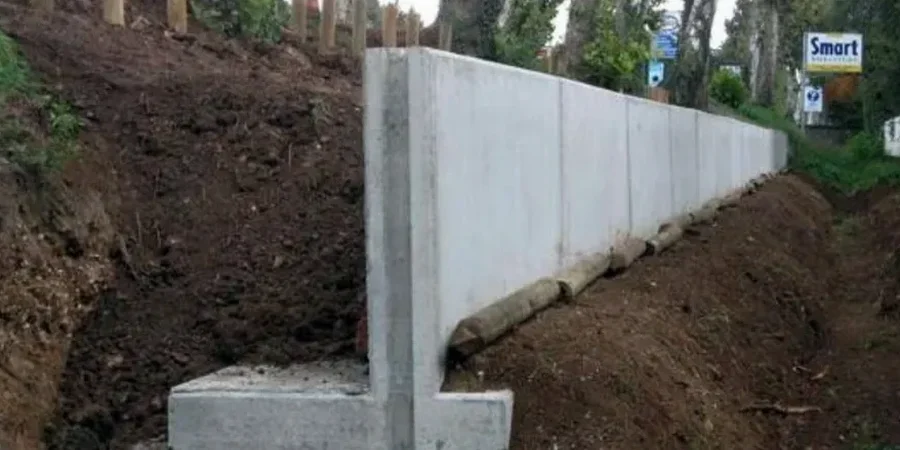
Manchester’s growth from a textile powerhouse along the Merrimack River into a modern New England hub left a patchwork of fill, dense glacial till, and sensitive marine clays beneath the city. Anyone who has excavated near Elm Street or the old millyard district knows the ground can change within a few feet. A retaining wall design here is not a catalog detail. The loading from saturated varved silts, the freeze-thaw cycles that chew on poorly drained backfill, and the lateral squeeze from ice-lensed soils demand a geotechnical approach that reads the site before it draws a single line. We combine subsurface data from test pits and lab classification to map where the competent bearing stratum actually sits, so the wall section is neither overbuilt nor skating on a thin crust of weathered drift over soft lake-bottom sediment.
A retaining wall in Manchester is only as good as the assumption about what sits beneath the footing — glacial till does not read the plans.
Top questions
What is the typical cost range for a retaining wall design in Manchester NH?
For a standalone retaining wall design with a site visit, subsurface data review, and stamped calculations, the fee typically runs between US$920 and US$4,000. The range depends on wall height, whether we need to run a slope stability model, and if new borings or test pits are required to supplement existing data.
Do I need a retaining wall design for a wall under 4 feet?
Strictly speaking, the IBC exempts walls under 4 feet from requiring a building permit in many cases, but that exemption assumes no surcharge and no sloping backfill. In Manchester, where frost action in silty backfill can easily heave a small wall out of alignment, we still recommend a basic geotechnical review for any wall retaining more than 3 feet of soil, especially if it is adjacent to a driveway or property line.
How do you handle groundwater behind the wall in Manchester's soils?
The glacial till and varved clay deposits around the Merrimack valley tend to perch water, so we specify a continuous granular drainage blanket behind the wall with a perforated collector pipe at the footing level, daylit or connected to a storm system. We also design the wall for a hydrostatic pressure case if the drain clogs, because in a Manchester winter, a frozen weep hole is a guaranteed headache.
What is the design life of a properly designed retaining wall?
A cast-in-place concrete retaining wall designed to IBC and ACI 318 standards, with proper drainage and concrete cover for New England exposure, should have a service life exceeding 50 years. The key driver in Manchester is the freeze-thaw durability of the concrete and the long-term performance of the drainage system, not the structural capacity of the steel.