In Manchester, contractors working near the Amoskeag Falls or along the Merrimack River quickly learn that water doesn't just flow on the surface—it moves through the glacial deposits underneath. A standard lab test on a disturbed sample won’t tell you how fast water actually travels through fractured rock or sandy till on site. That’s where the Lefranc and Lugeon field permeability tests come in. We run these tests to measure hydraulic conductivity directly in the borehole, giving you real numbers for dewatering system design or curtain grouting specs. Whether you’re sinking a deep excavation near Elm Street or planning a stormwater infiltration basin in the Goffstown Road industrial corridor, in-situ permeability data is what separates a dry, stable site from a costly mess. Our team brings ASTM D4630 and D4631 protocols to every job across Hillsborough County.
Lab permeability on a disturbed sample tells you about the soil; a field test tells you what the ground will actually do under real hydraulic gradients.
Local geotechnical context
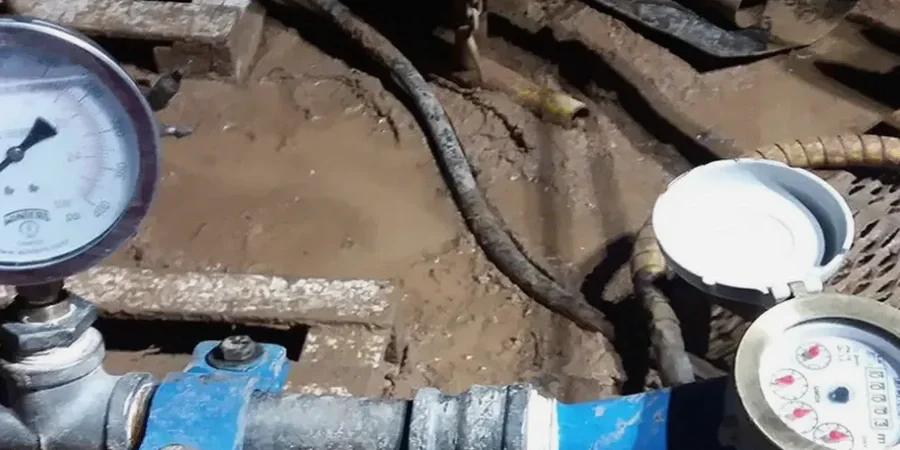
The equipment itself is straightforward but unforgiving: a double-packer assembly lowered on drill rods, a calibrated flow meter and pressure gauge at surface, and a water supply that must be clean enough not to clog the formation. In Manchester’s bedrock, we often use a single-packer setup with a downhole pressure transducer to eliminate friction losses in the rod—critical when you’re testing at 80 feet below grade near the Merrimack’s floodplain. If the packer doesn’t seat properly against a rough borehole wall, water bypasses it and the test is worthless. That’s why our drillers always ream the test interval carefully and log every fracture before inflating the packer. The real risk isn’t a bad test result—it’s acting on lab data alone and discovering groundwater during excavation that no one budgeted for. We’ve seen projects delayed six weeks because the geotechnical report assumed “average” permeability from a sieve analysis and didn’t run a field test in the critical layer. For grouting programs under the IBC, the Lugeon value directly determines cement take estimates and injection pressure limits—skip the test, and you’re guessing with someone else’s money.
Top questions
What does a field permeability test cost in the Manchester, NH area?
For a single Lefranc test at one depth interval in an existing borehole, budget between US$590 and US$930 depending on depth, access, and whether a packer setup is required. A full Lugeon test program in bedrock with multiple intervals will be on the higher end of that range per test, plus mob/demob if the rig isn’t already on site. We provide a firm quote after reviewing your boring logs and test depths.
Do I need a field permeability test, or is a lab permeability test enough?
Lab permeability tests (flexible-wall or constant-head) run on undisturbed samples are useful for homogeneous clay layers. But Manchester’s glacial soils are full of cobbles, lenses, and fractures that a 2-inch sample misses entirely. A field test measures a much larger volume of soil or rock and captures the influence of fissures and macro-porosity. For any project involving dewatering, infiltration, or grouting, the field test is the gold standard and often the only method accepted by regulatory reviewers.
How long does a typical Lugeon or Lefranc test take on site?
A single falling-head Lefranc test in granular soil usually runs 15 to 30 minutes. A Lugeon test in fractured rock takes longer—typically 45 to 90 minutes per interval—because we run multiple pressure steps (low-medium-high-medium-low) to detect hydraulic fracturing or dilation. With rig setup and packer seating, plan on a half-day for a two-interval rock program.