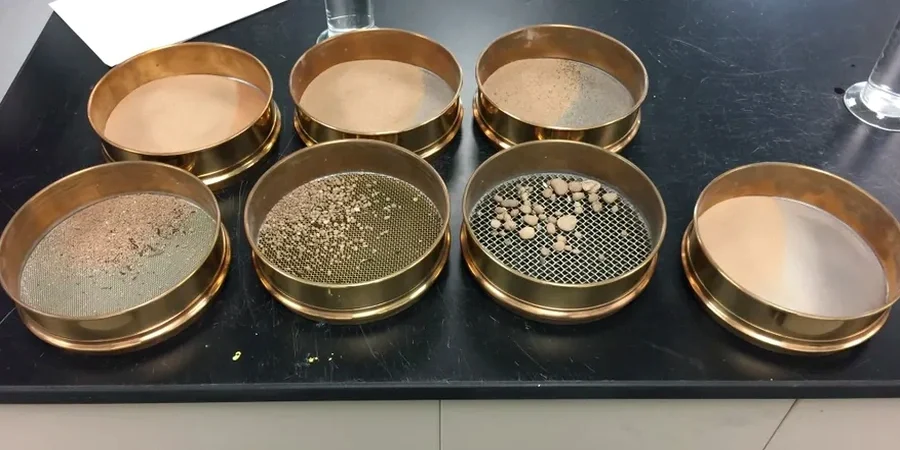
Manchester's mill-yard legacy left a patchwork of urban fill, glacial outwash, and varved clay deposits that still dictate foundation choices today. The Merrimack River terraces and the dense till underlying the old Amoskeag canal system create abrupt soil transitions over distances of just a few hundred feet. Our lab team runs combined sieve-and-hydrometer analysis under ASTM D6913 and D7928 to deliver the full particle-size distribution curve that structural engineers need for bearing-capacity verification and frost-protection design. We process samples from downtown high-rises, Elm Street commercial pads, and the residential subdivisions pushing into the sandy plains west of the airport. A grain size curve is never just a curve in Manchester — it is the first check against differential settlement in mixed glacial profiles. For deeper stratigraphic control we pair the hydrometer work with SPT drilling so the gradation log lines up with field blow counts.
A hydrometer reading at the 24-hour mark separates silt from clay, and in Manchester’s glacial-lake beds that distinction often determines whether a mat foundation works or a deep pile alternative is required.
Process overview
The wet-sieving stack and hydrometer sedimentation cylinder operate side by side on the bench, running from the No. 4 coarse sieve down through the No. 200 wash and into the Stokes’ law range below 0.075 mm. We pre-treat silty-clay samples with sodium hexametaphosphate dispersion and control the hydrometer bath at 20 °C per ASTM D7928, reading at 2, 5, 15, 30, 60, 250, and 1440 minutes. The resulting percent-gravel, sand, silt, and clay fractions feed directly into the Unified Soil Classification System (ASTM D2487) and AASHTO M 145 groups that govern pavement subgrade acceptance in Hillsborough County road contracts. When the material is borderline sand-clay, we extend the analysis with Atterberg limits on the minus-40 fraction so the plasticity index anchors classification where gradation alone is ambiguous.
Top questions
What does a combined sieve and hydrometer test cost in Manchester?
A complete grain size analysis with wash-sieve and full hydrometer sedimentation typically runs between US$90 and US$180 per sample, depending on whether the material is predominantly coarse or requires extended hydrometer readings. Soils with high clay content need longer dispersion and more reading intervals, which pushes the lab effort toward the upper end of the range. We quote a firm price after seeing the sample and confirming the scope with the project geotechnical engineer.
How long does the lab take to deliver the particle-size curve?
The hydrometer portion alone takes a minimum of 24 hours because the 1440-minute reading is required by ASTM D7928. Combined with overnight oven-drying, sieve shaking, and data reduction, most reports leave the lab within two to three working days. Rush service can compress that to 24-36 hours when the contractor hits an unexpected layer and needs the classification for a next-day footing inspection.
Which classification systems do you report for Manchester projects?
We provide both the Unified Soil Classification System (USCS) per ASTM D2487 and the AASHTO M 145 group classification on every report. Manchester building officials and NHDOT reviewers typically expect the AASHTO group for pavement subgrade acceptance, while structural engineers use the USCS symbol for foundation design and lateral-earth-pressure calculations.