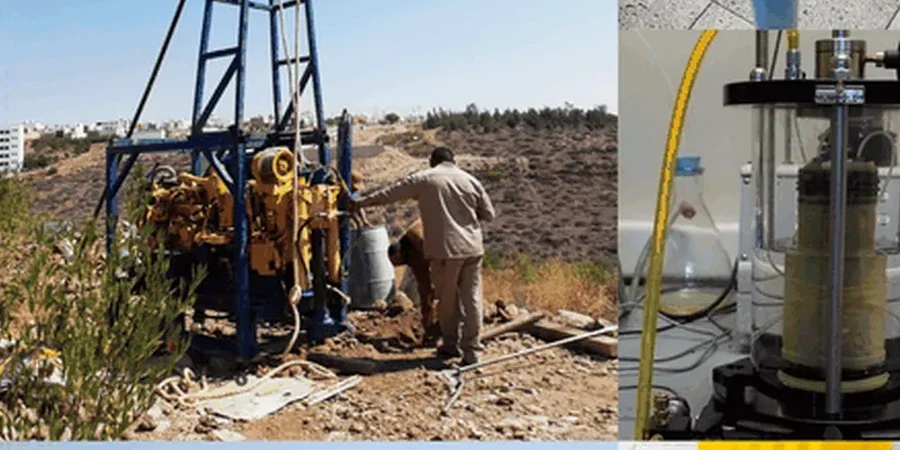
Manchester’s industrial legacy left more than just mill buildings along the Merrimack—it shaped the subsurface in ways that still challenge foundation design today. The Amoskeag Manufacturing Company built directly on river terrace deposits and glacial outwash, and modern projects in the Millyard and surrounding neighborhoods encounter those same variable stratigraphies. A soil mechanics study here has to account for discontinuous sand lenses, buried organic silt from the pre-industrial floodplain, and fill zones that date back to the 19th century. Our laboratory processes samples under ASTM D2487 classification protocols and runs direct shear and consolidation tests to build parameter sets that reflect actual ground behavior, not textbook assumptions. For sites near the river where soft clays appear at depth, we often recommend pairing the study with CPT testing to get continuous stratigraphy without disturbing sensitive samples.
A soil mechanics study isn't a commodity report—it's the difference between designing a footing at 2 ksf and knowing it actually works at 2 ksf.
Frequently asked questions
How much does a soil mechanics study cost for a typical residential project in Manchester?
For a single-family residential project in Manchester, a soil mechanics study with two borings, index testing, and a bearing capacity report runs between US$3,340 and US$4,740. The final number depends on depth to refusal, whether we need a drill rig versus hand-auger access, and the lab testing suite required. Commercial projects with deeper borings and advanced strength testing will scale upward.
How deep do borings need to go for a soil mechanics study in the Merrimack Valley?
Boring depth depends on foundation type and load, but in Manchester we typically extend borings to at least 6 meters below grade for shallow foundations and deeper where the Presumpscot Formation clays are present. For piles or drilled shafts, we go a minimum of 3 meters into competent bearing stratum. The IBC requires borings to penetrate any compressible layers that could contribute to settlement, and in the Millyard area we often find those layers extending past 12 meters.
What soil classification system do you use in your Manchester reports?
We classify all soils per ASTM D2487 using the Unified Soil Classification System (USCS). Every sample gets a two-letter designation—SP, CL, ML, etc.—plus a detailed description of color, consistency, moisture condition, and any secondary components noted during logging. For projects that interface with state agencies, we also cross-reference AASHTO classification when pavement design is part of the scope.